

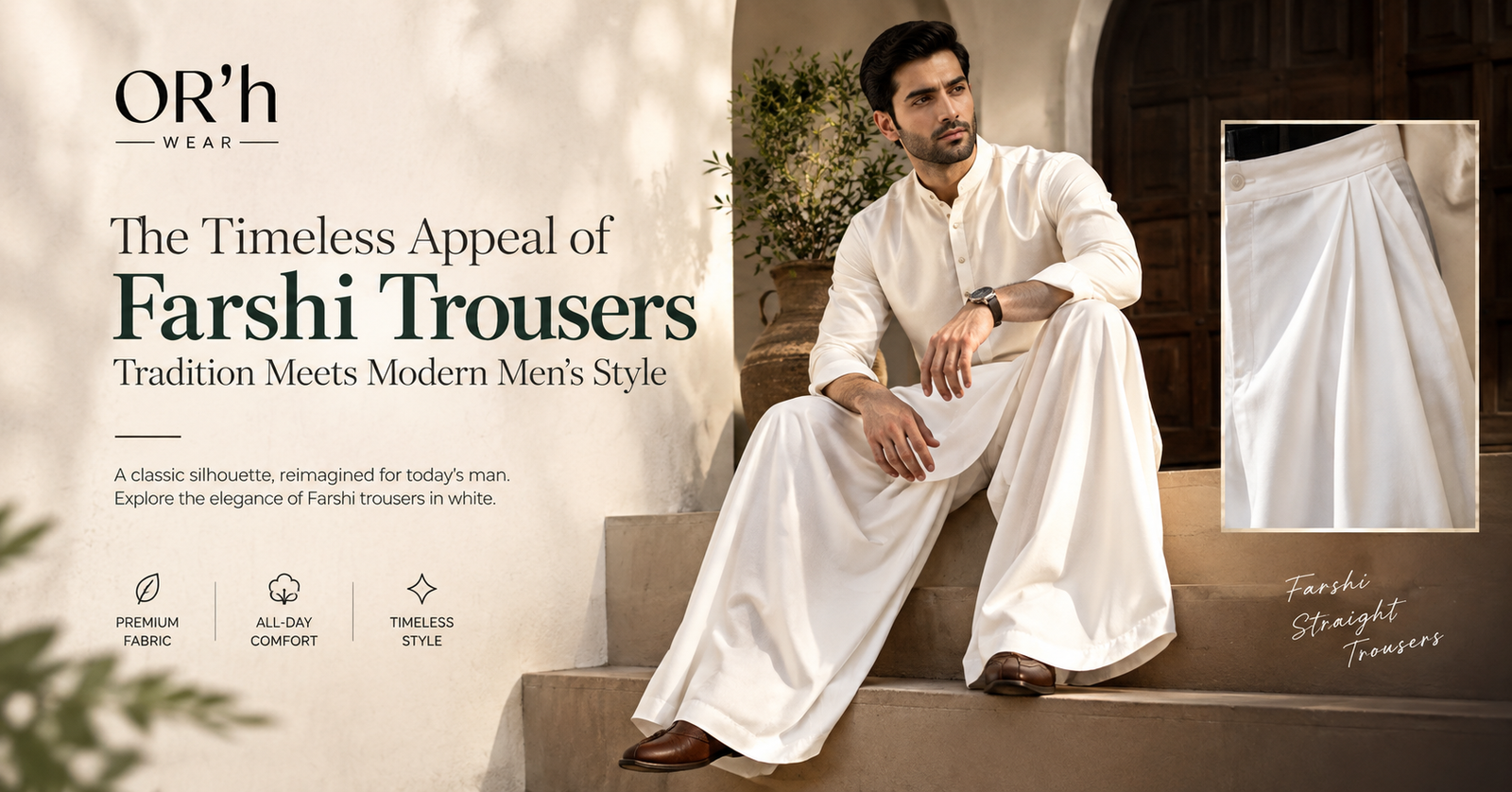
Traditional fashion has a way of coming back with a fresh identity. Styles that once belonged to a particular era can often find a new place in modern wardrobes, especially when designers reinterpret them for today’s generation. Farshi trousers are a good example of this shift.
Known for their wide, flowing shape and distinctive silhouette, Farshi-style trousers have gained renewed attention in South Asian fashion. While the traditional Farshi garment has deep roots in South Asian clothing, modern designers and fashion enthusiasts have adapted the silhouette in different ways, including contemporary styles for men.
But what exactly are Farshi trousers, where does the style come from, and how can men wear them today?
Let’s take a closer look.
What Are Farshi Trousers?
Farshi trousers are a wide and flowing style of traditional trousers known for their dramatic silhouette. The name “Farshi” is connected with the Persian word farsh, meaning “floor,” reflecting the garment’s historical association with fabric that could extend toward or trail along the floor.
Traditional Farshi garments were particularly associated with formal South Asian dress and were known for their generous use of fabric. The style created a distinctive, elegant appearance rather than the close-fitting shape seen in many modern trousers.
Today, the term Farshi trousers can refer to modern interpretations of this wide, flowing silhouette. For men, the style is often adapted into a more practical trouser shape that keeps the volume and traditional character while being easier to wear.
The result is a look that feels traditional without necessarily looking old-fashioned.
A Look at the History Behind the Farshi Style
The history of Farshi clothing is closely connected with the rich clothing traditions of South Asia. Historical Farshi garments are especially associated with women’s formal fashion in places such as Lucknow and with courtly and aristocratic dress. The long, flowing silhouette was designed to create a sense of grandeur and movement.
The style has also appeared in popular culture and period-inspired fashion, helping keep the distinctive silhouette familiar to new generations.
Over time, traditional clothing has naturally evolved. Designers have taken elements from older garments and adapted them to suit modern lifestyles. This is where the contemporary Farshi trouser comes in.
Rather than copying an old garment exactly, modern versions borrow the key idea — volume, flow and a statement-making silhouette — and reinterpret it for today’s wardrobe.
How Farshi Trousers Have Entered Modern Men’s Fashion
One of the interesting developments in South Asian fashion is the way traditional silhouettes are being reintroduced for men.
Modern men’s fashion is not limited to straight trousers, shalwars or conventional pants. Designers increasingly experiment with wider cuts, relaxed silhouettes and traditional influences.
Farshi-inspired trousers fit naturally into this movement.
For men, the modern interpretation usually focuses on creating a wide-leg or flowing appearance while keeping the garment practical enough for everyday movement. Instead of reproducing the historical garment exactly, contemporary versions can be paired with familiar men’s clothing such as kurtas, shirts, waistcoats and traditional footwear.
This makes the style easier to incorporate into a modern wardrobe.
What Makes Farshi Trousers Different?
The biggest difference is the silhouette.
Regular trousers generally follow the shape of the legs, whether they are slim, straight or relaxed. Farshi-style trousers are much more generous in width and fabric.
Here are some features that make them stand out:
Wide Silhouette
Farshi trousers usually have a noticeably wider shape than conventional trousers. This creates a relaxed and dramatic appearance.
Flowing Fabric
The extra fabric allows the trousers to move naturally while walking. Depending on the fabric and construction, this movement can become an important part of the overall look.
Traditional Influence
Although modern Farshi trousers can look very contemporary, their silhouette is inspired by traditional South Asian clothing.
Statement Appearance
Unlike basic trousers that usually play a supporting role in an outfit, Farshi trousers can become the main visual element.
This is one reason they work particularly well for people who want their traditional outfit to look different without relying entirely on embroidery or heavy embellishment.
How to Style Farshi Trousers for Men
Styling Farshi trousers doesn’t have to be complicated. The key is to balance the volume of the trousers with the rest of the outfit.
1. Farshi Trousers With a Kurta
A kurta is one of the most natural choices to wear with Farshi trousers.
A relatively clean and structured kurta can balance the wide silhouette of the trousers. For a traditional appearance, neutral shades such as white, cream, beige, black or earthy tones can work well.
2. Farshi Trousers With a Waistcoat
For weddings and formal events, a waistcoat can add structure to the outfit.
The combination of a flowing trouser silhouette with a fitted waistcoat creates an interesting contrast. You can keep the rest of the outfit relatively simple so the trousers don’t compete with too many other details.
3. Farshi Trousers With a Simple Shirt
For a more contemporary look, try pairing Farshi trousers with a simple shirt.
This approach removes some of the traditional elements and allows the trousers themselves to become the focus of the outfit.
A plain shirt works particularly well because the wide trousers already provide plenty of visual volume.
4. Traditional Footwear
Footwear can completely change the overall appearance of a traditional outfit.
For a more traditional look, men can consider classic South Asian footwear. For a modern interpretation, minimalist shoes can create a more contemporary contrast.
The important thing is to maintain balance between the trousers and footwear.
Choosing the Right Fabric
Fabric makes a major difference when it comes to Farshi trousers.
Lightweight fabrics can create more movement and a softer appearance, while heavier fabrics can give the trousers a more structured shape.
For warmer weather, breathable fabrics are generally more comfortable. For formal events, fabrics with a little more structure can help maintain the shape of the trousers.
When choosing fabric, think about three things:
- The weather
- The occasion
- How much volume you want in the silhouette
A very lightweight fabric may create a softer and more flowing look, while a structured fabric can make the outfit appear sharper.
Can Farshi Trousers Be Worn Casually?
Yes. They don’t have to be reserved for weddings or formal events.
A modern Farshi trouser can be styled casually by keeping the rest of the outfit simple. A plain shirt, basic kurta or understated top can help create a relaxed appearance.
The trick is not to overload the outfit.
If the trousers are already wide and visually distinctive, simple colors and minimal accessories can make the overall look feel more balanced.
This also makes Farshi trousers easier to introduce into a modern wardrobe.
Farshi Trousers for Weddings and Festive Occasions
Traditional clothing remains an important part of weddings and festive celebrations across South Asia.
Farshi trousers can work particularly well for these occasions because their unusual silhouette immediately gives an outfit a distinctive character.
For a wedding, men can pair them with:
- A formal kurta
- A waistcoat
- A textured or embroidered shirt
- Traditional footwear
- Minimal accessories
The goal should be to create a coordinated outfit rather than combining too many statement pieces.
For example, if the trousers have a strong silhouette, keeping the upper half relatively clean can make the outfit look more refined.
Farshi Trousers vs Regular Trousers
| Feature | Farshi Trousers | Regular Trousers |
| Silhouette | Wide and flowing | Straight, slim or relaxed |
| Fabric | Usually more generous | Usually more structured |
| Style | Traditional/statement | Everyday/formal |
| Movement | Loose and flowing | More controlled |
| Best suited for | Traditional and contemporary looks | Everyday and formal outfits |
| Visual impact | High | Usually more understated |
The easiest way to understand Farshi trousers is to compare them with regular trousers.This doesn’t mean one style is better than the other. They simply serve different purposes.
Regular trousers are usually easier for everyday wear, while Farshi trousers offer a more distinctive silhouette for people who want something different.
How to Choose the Right Fit
Although Farshi trousers are intentionally loose, that doesn’t mean every part of the garment should be oversized.
Pay attention to:
Waist
The waist should fit securely without feeling tight.
Length
Choose a length that works with the intended style. Extremely long versions may create a dramatic traditional appearance, while shorter modern versions can be easier for everyday wear.
Volume
The amount of fabric determines how dramatic the trousers look. If you’re new to the style, a moderately wide silhouette may be easier to wear.
Overall Balance
Think about the complete outfit rather than the trousers alone. A wide trouser usually works better when the upper part of the outfit has some structure.
Why Traditional Silhouettes Still Matter
Fashion constantly changes, but traditional silhouettes continue to influence modern clothing.
Part of their appeal comes from their ability to tell a story. A garment can carry elements of history, culture and craftsmanship while still being adapted to contemporary tastes.
Farshi trousers are an interesting example because their traditional inspiration gives them character, while modern styling makes them accessible to a new generation.
This is also why traditional Pakistani menswear continues to evolve instead of simply disappearing.
Farshi Trousers in Modern Men’s Wardrobes
The appeal of Farshi trousers comes from their flexibility.
They can be styled in a strongly traditional way with a kurta and waistcoat, or they can be combined with modern pieces for a more fashion-forward appearance.
This makes them useful for men who want to experiment with traditional clothing without wearing a completely conventional outfit.
The style also shows how fashion can move in both directions: modern clothing can borrow from history, while traditional clothing can be redesigned for modern lifestyles.
Final Thoughts
Farshi trousers offer an interesting way to bring traditional South Asian influences into modern men’s fashion. Their wide silhouette, flowing movement and distinctive character make them different from conventional trousers, while their styling possibilities allow them to work for both formal and contemporary outfits.
For men who want to experiment with this style, Or’h Wear also offers Farshi trousers for men, giving shoppers an opportunity to explore this distinctive silhouette as part of modern menswear.
You can explore the Or’h Wear pants collection to see how traditional influences can be incorporated into contemporary men’s clothing.
Ultimately, the appeal of Farshi trousers is not simply about following a fashion trend. It is about taking an element of traditional clothing and giving it a place in today’s wardrobe.